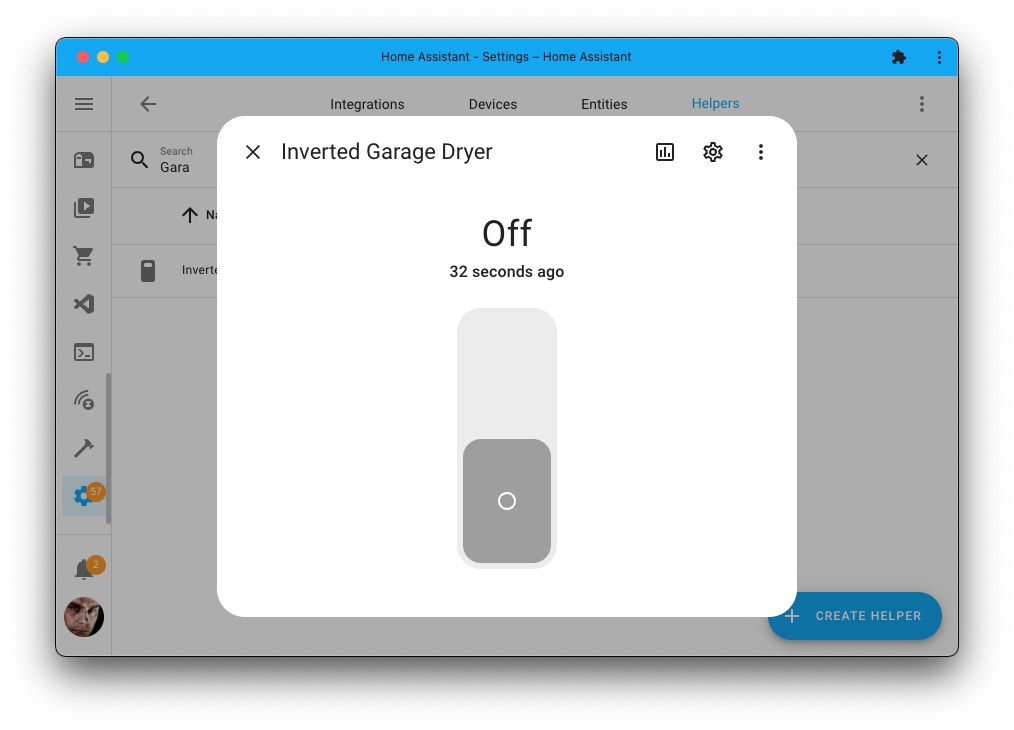
The inverse helper allows you to invert the behavior of a switch, binary sensor, cover, or valve entity. On becomes off, and off becomes on. Open becomes closed. The world is upside down!
This can be helpful if you use a switch or binary sensor in a non-standard way, or when the manufacturer of a device has decided to use the opposite logic for it (Yeah... they exist... 🤦♂️). Blinds with the motor mounted on the other side, a projector screen that opens by coming down: same story.
It not just inverts the state of the source entity, but also does all actions in reverse. So if you have an automation performing the turn on action on a switch, it will instead perform the turn off action on the inverted switch.
What can be inverted
An inverted switch can be made of a switch, an on/off toggle helper (
input_boolean), or a light. Turning the inverted switch on turns the source off, with the source’s own actions: a light is turned off as a light.An inverted binary sensor can read a binary sensor, an on/off toggle helper, or a light.
An inverted cover or valve is made of a cover or a valve, as explained below.
A light inverted as a switch is only on or off: its brightness, colors and effects stay with the light itself.
Inverting a cover
A cover can be backwards in two ways, and the inverse helper lets you turn around either one, or both:
Invert opening, closing and position (on by default): opening becomes closing and the other way around, and a position becomes its opposite. A cover that is 30% open is shown as 70% open, and telling the inverse to go to 70% sends the source to 30%.
Invert tilt (off by default): the same for the tilt of the slats. Handy for blinds that open and close fine, but tilt the wrong way.
The position decides whether the inverted cover is closed, not the state of the source. A cover counts as closed only at exactly 0%, and as open at anything above that. So the inverted cover is closed only when the source is all the way open. A cover that cannot report its position only knows open or closed, and has just that turned around.
Inverting a valve
A valve works the same way as a cover, without the tilt: opening becomes closing, a position becomes its opposite, and the inverted valve is closed only when the source is all the way open. There are no extra options, as a valve only moves one way.
Inverting the behavior of an entity
The inverse helper can be used to invert the behavior of a switch, binary sensor, cover, or valve entity.
Don’t worry! This is really easy and all fully done via the Home Assistant user interface.
Add one directly to your own instance by selecting the My Home Assistant button below:

Or add one manually, using the following steps:
From the Home Assistant sidebar, select Settings and next select Devices & Services.
Select the Helpers tab.
On the helpers page, in the bottom right corner, select the + Create helper button.
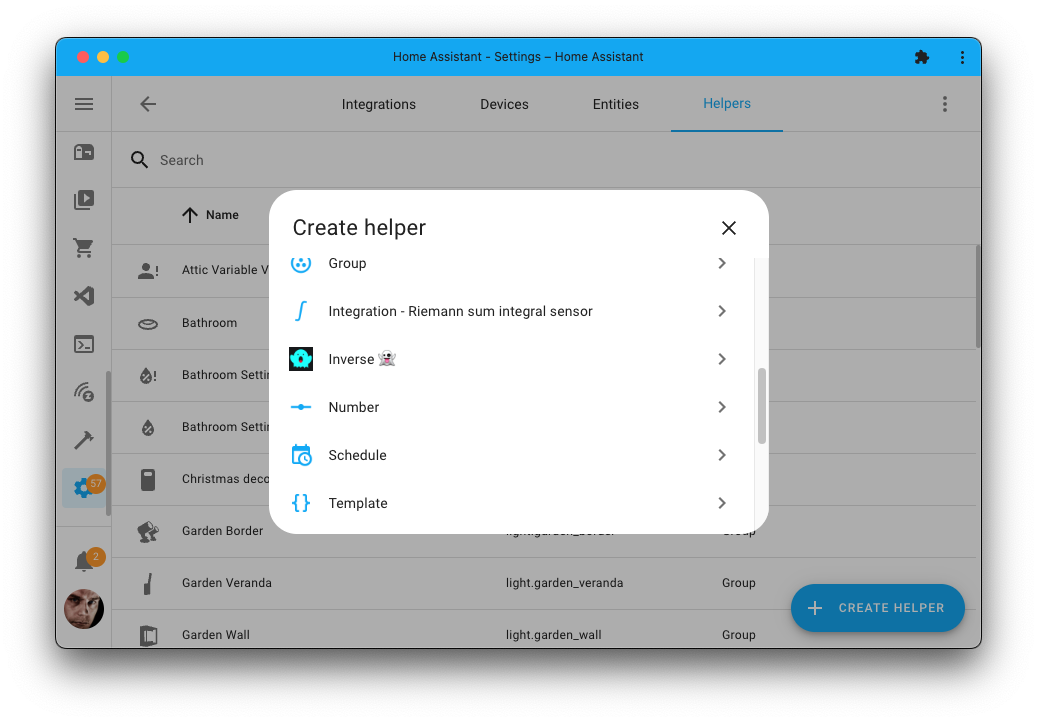
From the list of helpers, select Inverse 👻.
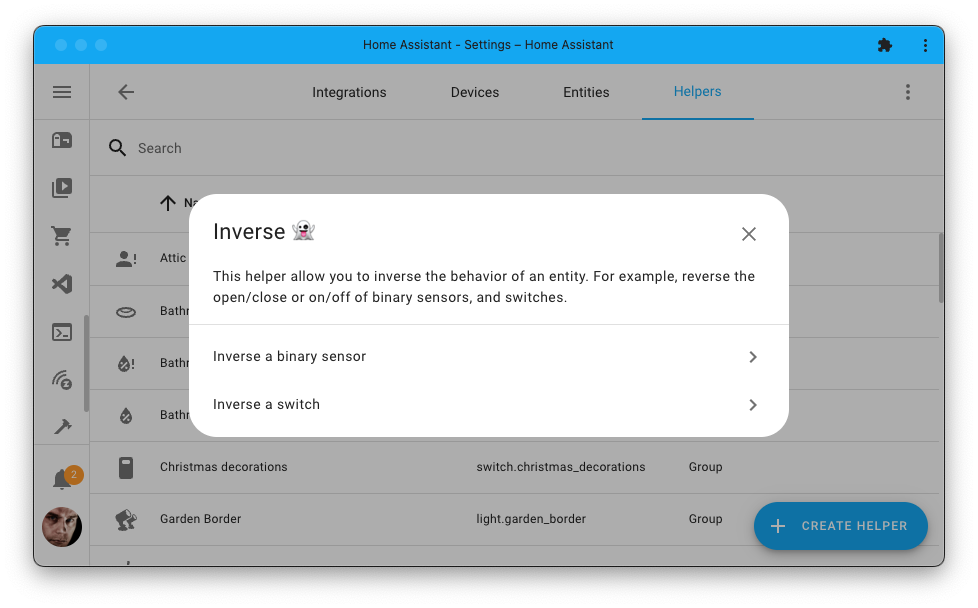
Select the type of entity you want to invert the behavior of.
Provide a name for your new inverted entity this helpers provides, and select the entity you want to invert the behavior of in the Source entity field.
Turn on Hide source entity, if you want to hide the source entity from the Home Assistant interface.
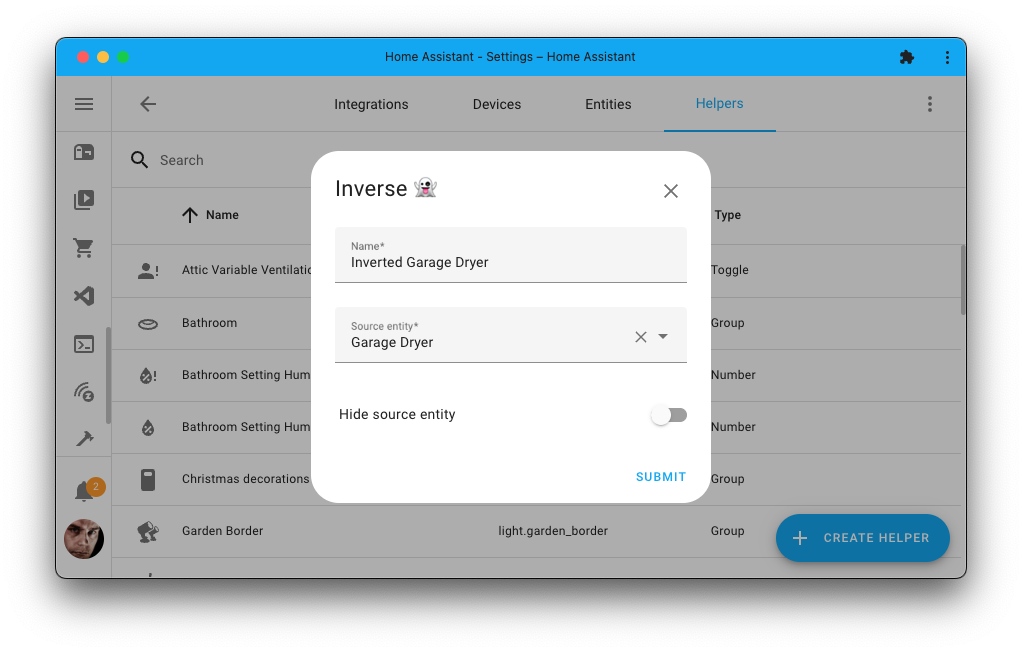
Select Submit. Done! 🎉